
Education should do more than help you pass exams.
It should help you understand your world, question what limits you, build useful skills, and participate in changing your community. That is the heart of emancipatory education.
For Africa, this matters deeply. Many young people have gone through school, earned certificates, and still feel unprepared to lead, build, organize, solve problems, or create economic value. The issue is not that education is useless. The issue is that too much learning stops at information.
Emancipatory education asks a stronger question:
What kind of person does education produce?
Does it produce someone who repeats what they were told, waits for permission, and chases paper qualifications? Or does it produce someone who can think, organize, cooperate, create, and act responsibly?
What Emancipatory Education Means
Emancipatory education means learning that frees the mind and strengthens the person’s capacity to act.
It does not mean rejecting school, teachers, books, or formal qualifications. It means refusing an education system where learners only absorb information without understanding how knowledge connects to life, work, leadership, and community transformation.
In simple terms, emancipatory education helps you:
- Think independently
- Question inherited assumptions
- Understand social and economic realities
- Build practical skills
- Take responsibility
- Work with others
- Create solutions instead of only describing problems
UNESCO’s work on global citizenship and peace education connects education to helping learners understand the world and work together on major shared problems. That idea is close to the spirit of emancipatory education because it treats learners as active participants in society, not passive receivers of information.
Why Traditional Learning Often Stops at Information
Many African students know what it means to study mainly for exams.
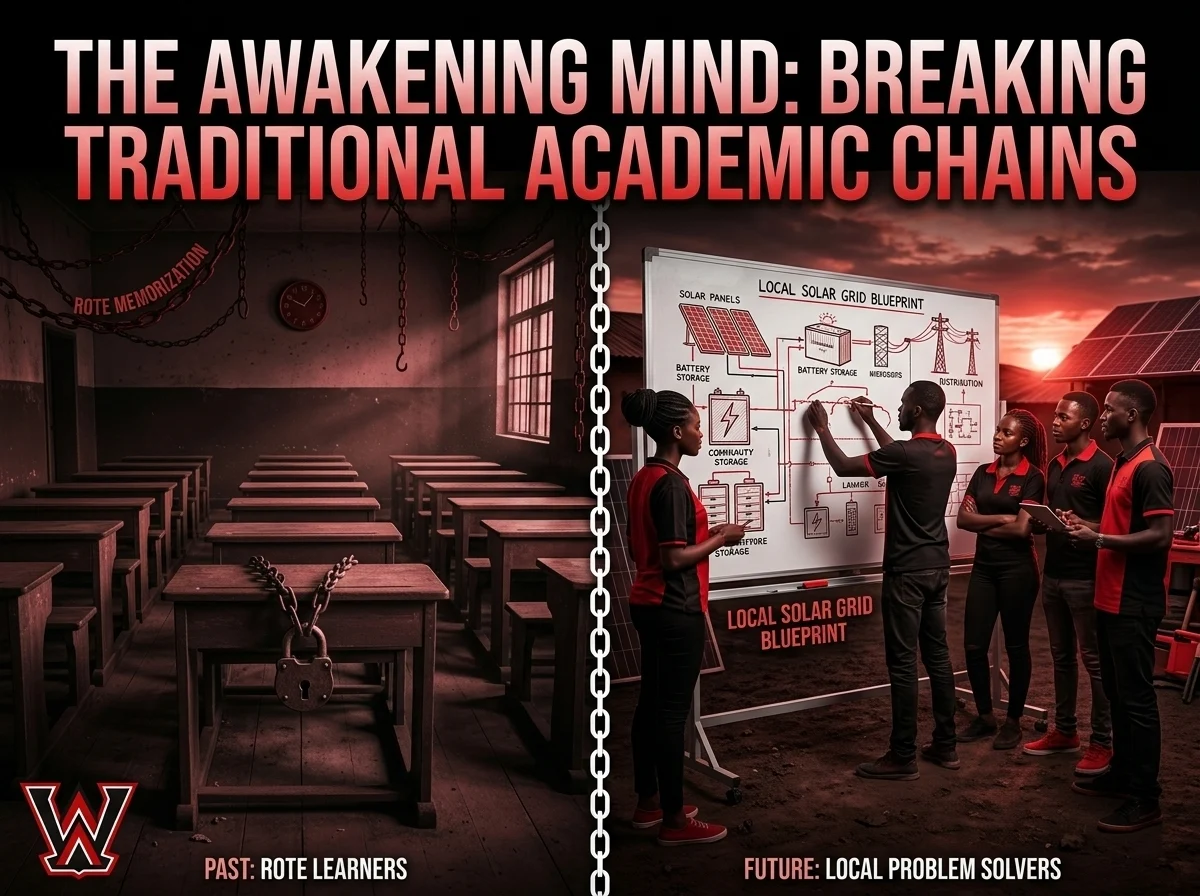
You memorize definitions, reproduce notes, pass the paper, and move to the next level. But after the exam, you may still struggle to speak confidently, analyze a community problem, design a project, manage money, start an initiative, or lead a team.
That is information without agency.
Traditional learning often stops at information when it rewards repetition more than understanding. A student can explain entrepreneurship in theory but has never tested a small business idea. A graduate can define leadership but has never organized people around a shared goal. A young professional can describe development but cannot map the practical problems in their own community.
This is why African education reform cannot focus only on more classrooms, more exams, or more certificates. Those things matter, but they are not enough. The African Union’s Continental Education Strategy for Africa 2026–2035 points toward education systems that support skills, innovation, inclusion, and development, not schooling as an isolated activity.
How Education Can Build Agency
Agency means the ability to make choices, take initiative, and act meaningfully within your environment.
A person with agency does not wait for perfect conditions before doing anything. They study their situation, identify available resources, organize with others, and begin where they are.
Education builds agency when it teaches learners to ask:
What is happening around me?
Why is it happening?
Who is affected?
What knowledge or skill can help?
What can I do with others to improve the situation?
This kind of learning changes the student’s posture. Instead of saying, “There are no opportunities,” the learner begins asking, “What problems are people facing, and what useful solution can I help build?”
That mindset is essential for African youth because many communities face real constraints: unemployment, weak infrastructure, underfunded schools, informal work, limited access to capital, and uneven digital access. Emancipatory education does not pretend these problems are easy. It teaches young people how to confront them with intelligence, discipline, cooperation, and courage.
The World Bank’s Learning Poverty Briefs show why learning quality matters, not just school attendance. When learners are in school but do not gain strong foundational skills, their future economic and civic choices become limited.
What Emancipatory Education Looks Like in Practice
Emancipatory education is practical. It does not stay in speeches.
In a classroom, it may look like students investigating a local problem, interviewing community members, and designing a small intervention.
In a training program, it may look like participants learning leadership through actual group responsibility, not just lectures on leadership theory.
In entrepreneurship, it may look like young people building cooperative business models that respond to real needs instead of copying business ideas that do not fit their context.
In community work, it may look like learners organizing a clean-up project, financial literacy workshop, tutoring circle, food initiative, digital skills session, or local enterprise experiment.
The point is not that every project must become large immediately. The point is that learning must move from the head to the hand, from theory to action, from self-improvement to shared progress.
UNESCO’s education work in Africa emphasizes inclusive, quality education, literacy, skills, lifelong learning, technical and vocational education, and ICT-supported learning. These priorities matter because practical education for African youth must connect knowledge to employability, citizenship, creativity, and social contribution.
Example 1: Leadership That Starts With Responsibility
In passive education, leadership is a title.
In emancipatory education, leadership is responsibility.
A young person does not become a leader only because they are called president, coordinator, founder, or class representative. They become a leader by learning to listen, make decisions, serve others, manage conflict, communicate clearly, and remain accountable.
For example, a student group that organizes a community reading club learns more than event planning. They learn how to mobilize people, manage time, solve disagreements, communicate with parents, and measure whether children are improving.
That is leadership education in practice.
Example 2: Enterprise That Solves Real Problems
Emancipatory education does not treat entrepreneurship as a motivational slogan.
It asks young people to understand problems deeply before building enterprises.
A certificate-chasing mindset asks, “What job can I get with this paper?”
An emancipatory mindset also asks, “What value can I create with what I know?”
For example, young people in an agricultural community may study food waste, storage challenges, transport gaps, or market access. From there, they can explore small processing, cooperative distribution, digital market information, or local packaging solutions.
This does not romanticize poverty or tell young people to create businesses without support. It simply shifts education from waiting to building.
Example 3: Community Work That Produces Learning
Community work is not charity when it is done with reflection, structure, and accountability. It becomes a learning laboratory.
A group that teaches digital literacy to market women learns communication, patience, curriculum design, local language adaptation, and practical problem-solving.
A group that supports waste collection learns public health, behavior change, logistics, municipal systems, and community mobilization.
A group that mentors younger students learns responsibility, empathy, teaching, and long-term commitment.
These experiences make education transformative because learners are not only studying society. They are participating in it.
How Wake Up Africa Applies the Idea
Wake Up Africa’s approach reflects emancipatory education because it connects learning to autonomy, cooperation, leadership, enterprise, and sustainable development.
According to its official website, Wake Up Africa presents itself as a community-driven initiative focused on education, innovation, volunteering, and sustainable development projects in Africa. Its training program includes disciplines such as cooperative governance, emotional intelligence, neo-collectivist entrepreneurship, circular economy, intra-African trade, stoic leadership, and applied ethics.
That matters because emancipatory education is not only about gaining personal confidence. It is about preparing people to build systems with others.
Our “Who We Are” page describes that we are centered on autonomy, cooperation, sustainable development, youth, innovation, and human complementarity. You can review the page here Who We Are page.
This is where the idea becomes practical for a training applicant.
If you join a program shaped by emancipatory education, you should not expect only lectures. You should expect to be challenged in how you think, how you work with others, how you handle responsibility, and how you turn ideas into community value.
The question is not only, “What will I learn?”
The deeper question is, “What kind of African builder will this learning help me become?”
Why Emancipatory Education Matters Now
Africa does not only need more educated people. It needs people whose education has prepared them to think clearly, build ethically, cooperate across differences, and solve problems that affect real communities.
Certificates can open doors, but they cannot replace judgment. Memorization can help you pass exams, but it cannot replace initiative. Information can fill the mind, but it cannot automatically produce courage, discipline, enterprise, or leadership.
Emancipatory education matters because it restores the purpose of learning.
You are not learning only to escape your community. You are learning to understand it, improve it, build from it, and connect it to wider African possibilities.
That is the kind of education Africa needs now: education that frees the mind, strengthens the hand, forms character, and turns young people from passive observers into responsible builders.